On this page
- Where each breed actually comes from
- The first year: what actually shows up, and when
- Health risks worth screening for in both breeds
- Daily life: exercise, mental work, and the off-switch
- The counterargument I hear most, and why I still land where I do
- Choosing between them: a scene from the exam room
- The short version
Before the prose, here’s the decision checklist I actually use with clients weighing these two breeds:
- Exercise ceiling: Border Collies generally need more sustained, high-intensity work than Australian Shepherds — if you can’t hit 90+ minutes of real activity most days, neither breed is a good fit, but the Border Collie will show it faster.
- Off-switch: Australian Shepherds are somewhat more likely to settle indoors after work is done; Border Collies tend to stay “on” longer.
- People-orientation: Aussies are frequently described as more velcro and eager to be underfoot; Border Collies can be more independently task-focused.
- Drug sensitivity: Both breeds carry meaningful rates of the MDR1 mutation — this changes how certain medications should be dosed, and it’s worth testing for either dog.
- Joint health: Hip dysplasia risk exists in both lines; neither breed is “safe” from it by default.
- First-time owner fit: Neither breed is a good match for a first dog in a low-activity household — full stop.
Myth correction first, because I hear this one every week: the idea that Australian Shepherds are “the calmer version” of a Border Collie. They’re not calm dogs. They’re differently intense dogs. That distinction is the whole article.
Where each breed actually comes from
The Border Collie was bred in the borderlands between Scotland and England to gather and move sheep across open, uneven terrain with almost no verbal direction — the dog reads the handler’s body and the stock’s behavior simultaneously. That history shows up in the Official Standard of the Border Collie, which describes the breed as an “intense worker of great tractability” that is “affectionate towards friends” but “may be sensibly reserved towards strangers.”
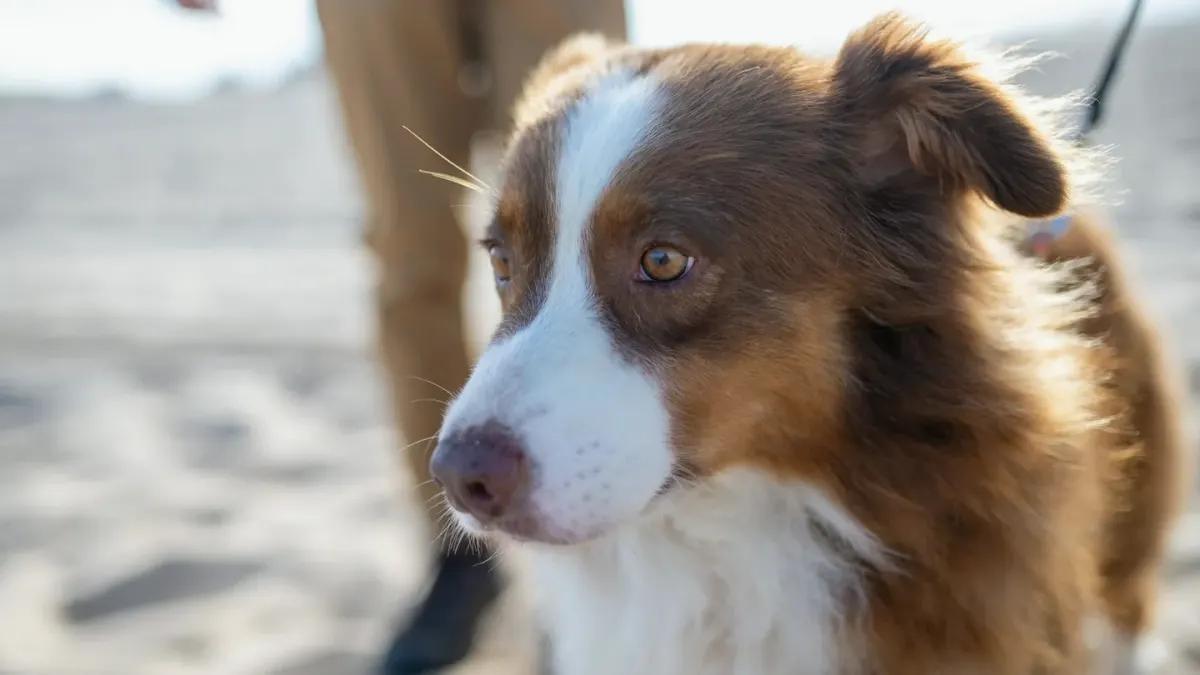
The Australian Shepherd, despite the name, was developed in the American West, likely from herding stock that arrived with Basque shepherds and Merino sheep flocks, and it was later shaped by ranch work and rodeo culture. According to Australian Shepherd Dog Breed Information, the breed carries “strong herding and guarding instincts” and stamina to work all day, with a temperament that’s active but even — good-natured rather than laser-focused.
That founding difference — gathering sheep across a hillside versus working close-in with cattle and guarding a homestead — is why the two breeds feel different in a living room, even though both are whip-smart.
The first year: what actually shows up, and when
In my practice, the pattern is remarkably consistent. I had a client with an 8-month-old Border Collie, about 32 pounds, who came in because he’d started chewing through the drywall behind the couch — always in the late afternoon, always after the owner got home from work and hadn’t yet taken him out. She’d assumed a 20-minute yard session covered his needs. It didn’t come close. Over about six weeks of adding a second structured session — a 30-minute flirt-pole or fetch block before dinner — the drywall chewing stopped and his recall in the yard sharpened noticeably. I’ve seen the same story with Australian Shepherd puppies too, but it usually shows up as pacing and shadowing the owner room to room rather than destruction, because Aussies tend to funnel that energy into staying close rather than finding a project.
Both breeds go through a rough adolescent stretch, typically starting around five to seven months, where herding instinct — nipping at heels, circling joggers, “eyeing” children — becomes impossible to ignore. This is genetic behavior surfacing, not a training failure, and it responds best to redirection (a flirt pole, a job, structured fetch) rather than punishment.
Health risks worth screening for in both breeds
Hip dysplasia is a real risk in both lines. It isn’t a Border Collie-specific or Aussie-specific problem — it shows up whenever hip joints develop with poor conformation, and either breed can inherit it. If you’re comparing breeders, ask for OFA or PennHIP hip scores on both parents regardless of which breed you land on.
The other one I flag for every herding-breed client, without exception, is the MDR1 (ABCB1) drug-sensitivity mutation. Per the MDR1 FAQs from the Australian Shepherd Health & Genetics Institute, dogs carrying this mutation can react severely to certain drugs — including some common parasiticides and anesthetics — at doses that are perfectly safe for dogs without it. Rates are high in both breeds. A simple cheek-swab test tells you whether your dog carries one or two copies, and I recommend it before any elective surgery or new medication, not after a scare.
Neither breed’s joint or drug-sensitivity risk is something a supplement fixes. What structure/function support can reasonably do is help maintain healthy joint comfort and mobility once a dog is already active and aging — it’s a maintenance layer, not a substitute for genetic screening. If you’re building that kind of plan for an older herding dog, our guide to the best joint supplements for senior dogs walks through what ingredients actually have evidence behind them.
Daily life: exercise, mental work, and the off-switch
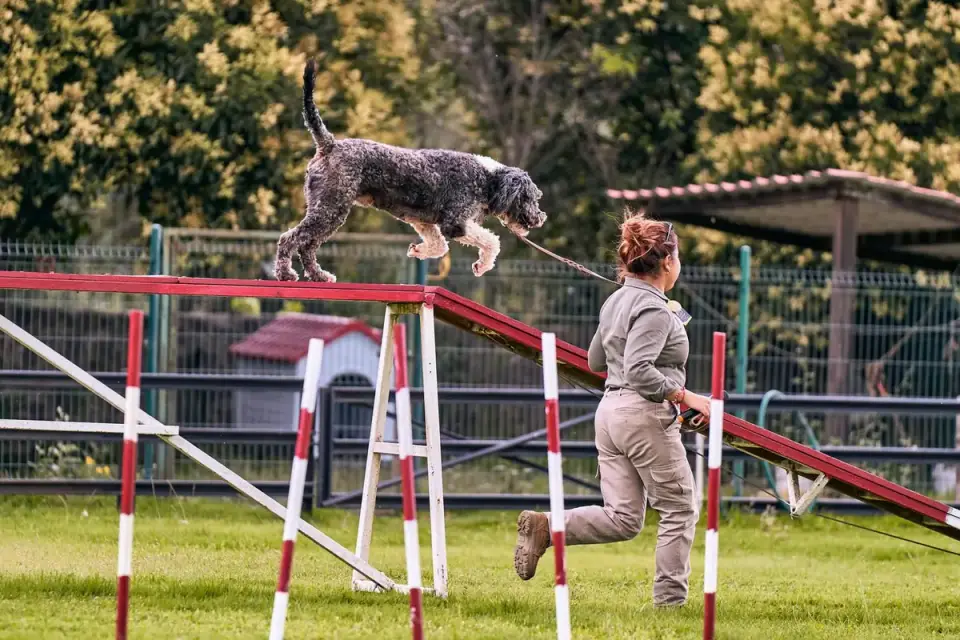
Border Collies are widely regarded as the most trainable dog breed, and that trainability is inseparable from their need for a job. Without one, they tend to invent their own — herding children, shadows, cars, or vacuum cleaners. Realistic daily expectations: 90 minutes or more of real physical and mental work, ideally split across two sessions, plus some kind of ongoing “job” — agility, flyball, nose work, or actual herding if it’s available.
Australian Shepherds need nearly as much, but I’ve found their threshold for satisfaction is slightly more forgiving. A 45-to-60-minute structured session plus a job around the house — supervising kids, “helping” with yard work — often keeps an Aussie settled in a way that the same routine wouldn’t for a Border Collie.
One short truth that’s easy to miss in all the comparison charts: neither breed does well bored and alone for eight-hour stretches.
Fiber, gut health, and general nutrition matter more than people expect for high-drive dogs, since digestive upset can look a lot like a behavior problem in an anxious or under-exercised herding dog. If you’re troubleshooting loose stool in a high-activity dog, it’s worth reading how much is too much — see Can a Dog Have Too Much Fiber? — before assuming it’s purely behavioral.
The counterargument I hear most, and why I still land where I do
The strongest pushback I get is: “My Aussie is just as intense as any Border Collie I’ve met.” That’s fair — individual variation within both breeds is real, and a poorly bred or under-stimulated Aussie from working lines can absolutely out-exercise a couch-potato Border Collie. But at the population level, the breed standards themselves encode the difference: the Border Collie standard is built entirely around sustained, independent working drive at a distance from the handler, while the Aussie standard emphasizes an even disposition and close partnership. If you’re choosing based on averages — which is what most first-time owners are actually doing — the Border Collie sits further out on the intensity curve, and I’d be doing clients a disservice to pretend otherwise.
Choosing between them: a scene from the exam room
A family came in last spring deciding between the two, and the conversation that mattered wasn’t about coat color — it was about what happened at 6 p.m. on a Tuesday. Both parents worked from home, one full-time and one part-time, with two kids under ten. They’d fallen for a Border Collie’s ears and a friend’s Aussie puppy photos on the same weekend. I asked them to describe an actual weekday evening: dinner prep, homework, dishes, bedtime. Neither parent had 90 uninterrupted minutes free most days — closer to 45, split in two chunks. I told them honestly that a Border Collie in that house would likely end up frustrated and destructive by month four, based on what I’ve seen play out with similar schedules. They went with the Aussie, added a weekly agility class for structured burn-off, and by the six-month checkup the dog was settling on a mat during dinner — not perfectly, but enough that nobody was in crisis. That’s the kind of fit conversation this decision actually deserves.
If you’re weighing calming support for a high-strung herding dog around fireworks, vet visits, or travel, our comparison of chamomile vs L-tryptophan covers what the evidence says about each, and what a well-formulated chew combines them for.
The short version
Both breeds are working dogs first and pets second, and neither forgives being treated like a couch companion. The Border Collie asks for more sustained physical and mental output and holds its edge longer into the evening; the Australian Shepherd asks for slightly less raw volume but more physical closeness and involvement in the household’s actual routine. Screen for hip dysplasia and MDR1 status in either breed before you commit, not after a problem shows up. If your household’s honest daily bandwidth is under 60 minutes of real activity, I’d steer you toward neither breed rather than pretend one is the “easy” option — but if you’re building toward more active years ahead, both dogs reward the owner who shows up consistently.
Frequently asked questions
Are Border Collies or Australian Shepherds better with kids?
Both can do well with children when properly exercised and supervised, but Australian Shepherds are more often described as closely bonded and people-oriented, while Border Collies may try to "herd" running children if under-exercised.
Do both breeds need the MDR1 drug-sensitivity test?
Yes — both breeds carry meaningful rates of the MDR1 mutation, and testing before surgery or starting a new medication is a reasonable precaution regardless of which breed you own.
Which breed is easier for a first-time owner?
Honestly, neither is ideal for a first dog in a low-activity household. Both need an experienced, active owner willing to provide structured daily work.
Sources
- Official Standard of the Border Collie — American Kennel Club
- Australian Shepherd Dog Breed Information — American Kennel Club
- MDR1 FAQs — Australian Shepherd Health & Genetics Institute