
On this page
I once watched an owner hand her twelve-year-old Cattle Dog a piece of salmon skin straight off the grill — crispy, seasoned with garlic butter, still warm from a Sunday cookout. Within an hour the dog was pacing, drooling, and refused her dinner. Nothing catastrophic happened that time, but it wasn’t the salmon that worried me. It was the butter, the garlic, and the fact that nobody had checked whether the fish was actually cooked through before it hit the grass. That’s the pattern I see over and over: the fish itself is rarely the problem. The prep is.
So can dogs eat cooked salmon? Yes — plain, boneless, and cooked through, it’s one of the better fish options for most dogs. The more useful question is what “cooked through” and “plain” actually mean in practice, because that’s where owners get tripped up.
Why doneness matters more than the fish itself
Raw or undercooked salmon carries a real risk that plain cooking eliminates. According to UC Davis School of Veterinary Medicine, salmon poisoning disease is caused by a parasitic fluke, Nanophyetus salmincola, embedded in raw or undercooked salmonid fish (salmon, trout, char) that carries the bacteria Neorickettsia helminthoeca. Clinical signs — high fever, bloody diarrhea, vomiting, and profound weight loss — generally show up within about six days of a dog eating infected fish, and the disease is treatable with antibiotics and a dewormer but can be fatal if it’s missed. The catch is geography: it’s confined to the Pacific Northwest, from northern California up through Alaska, so a dog in Ohio eating raw salmon isn’t facing that specific threat — but I still don’t recommend raw salmon for any dog, because the geographic line isn’t something most kitchens can verify at the point of purchase.
Cooking solves this. Bringing salmon to an internal temperature of 145°F, the standard food-safety threshold cited by outlets like the Can Dogs Eat Salmon?: AKC, kills the parasite and the bacteria it carries. That’s the entire reason “cooked” is doing so much work in the question “can dogs eat cooked salmon” — it’s not a texture preference, it’s the safety threshold.
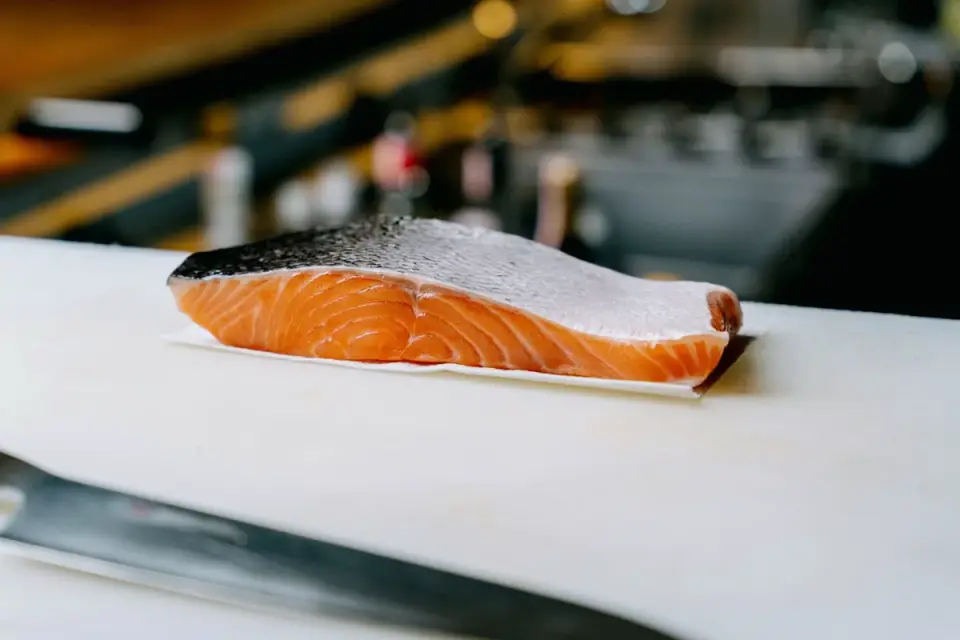
The bones are the part owners forget
Bones are the second real hazard, and they get less attention than the raw-fish question even though I see them cause more emergency visits. Salmon bones, especially the fine pin bones that run down the fillet, can lodge in a dog’s throat or esophagus, or make it further down and scrape or perforate the digestive tract. That’s not a hypothetical — it’s the standard concern flagged across veterinary and pet-nutrition sources discussing salmon safety, and it’s exactly why boneless, filleted salmon is the version worth feeding. Whole cooked salmon carcasses, however tempting for a dog nosing around the kitchen, are not worth the risk.
If you’re new to feeding fish and want a broader sense of what other “can my dog eat this” foods look like once you strip away the marketing, our guides on whether onions are toxic to dogs and how much banana is actually reasonable cover two foods with very different risk profiles — one is a hard no, the other is mostly a portion question, and salmon lands closer to the banana camp once the bones and seasoning are handled.
What salmon is actually contributing to the bowl
This is where I put my nutritionist hat back on. Salmon is a genuinely useful source of omega-3 fatty acids, and dogs can’t synthesize these on their own — they have to come from diet. Omega-3s support skin and coat quality, have anti-inflammatory effects, and are one of the more evidence-grounded additions for joint comfort in aging dogs, a claim documented by the Fish Oil for Dogs: What to Know: AVMA-referenced discussion of fish oil in dogs. I weigh salmon the same way I’d weigh a fish-oil supplement: it’s not a cure for anything, and one meal of salmon isn’t going to transform a dog’s coat or joints. What it can realistically do is contribute a well-tolerated protein and a meaningful fatty-acid boost, especially for dogs whose regular diet is light on omega-3s.
A balanced gut also matters for how well a dog tolerates any new protein, cooked or otherwise. A balanced gut microbiome supports overall immune function. That’s worth keeping in mind if you’re introducing salmon to a dog with a sensitive stomach — start with a small portion and watch the following 24 hours the way you would with any new ingredient.
The seasoning trap
Plain is doing real work in “plain, boneless, cooked salmon.” Garlic, onion, excess salt, and butter or oil used in most grilled or pan-seared preparations are the actual danger in the scenario I described earlier, not the fish. If you’ve read our piece on why onions are simply off the table for dogs, you already know how little tolerance most owners should have for allium seasoning anywhere near a dog’s plate. The safest approach is to set aside an unseasoned piece before you season the rest for the table — poached, steamed, or baked with nothing but the fish itself.
In my practice, the dogs who do best with an occasional salmon meal are the ones whose owners treat it as a rotation protein, not a daily habit — a few times a month, plain, in a portion sized to the dog’s normal calorie needs. I had a twenty-six-pound Corgi mix in for a wellness recheck a few years back whose owner had started swapping in a golf-ball-sized portion of baked salmon twice a week after her usual kibble ran low on fish oil; her coat noticeably softened over about six weeks, and her stool stayed normal throughout, which told me the swap was well tolerated rather than disruptive. That’s the outcome I look for — not a transformation, just a food that fits without causing GI upset.

Where this actually lands
Cooked, boneless, unseasoned salmon is one of the more defensible fish choices for a dog’s diet — not because it’s a superfood, but because the risks are specific and manageable: cook it through, pull the bones, skip the seasoning, and keep the portion modest. The counterargument I hear most is that raw or lightly seared salmon is “more natural” or preserves more nutrients, and there’s a kernel of truth in that for the omega-3 content. But the downside of getting doneness wrong — even outside salmon poisoning disease’s Pacific Northwest range — includes ordinary foodborne bacteria and parasites that cooking reliably handles. I still land on cooked, every time, because the marginal nutrient loss from cooking is a much smaller cost than a preventable GI illness. If you want the omega-3 benefit without the prep risk, a fish-oil supplement dosed to your dog’s weight is often the more consistent choice; salmon itself is best treated as an occasional, well-prepared addition rather than a dietary cornerstone.
Frequently asked questions
Can dogs eat cooked salmon skin?
Plain, cooked salmon skin isn't toxic, but it's higher in fat than the fillet and is usually the part cooked with butter, oil, or seasoning at the table — which is the actual risk. If you're offering skin, cook it separately with nothing added.
What if my dog eats raw salmon by accident?
Watch for fever, vomiting, or bloody diarrhea over the following week, especially if you're in the Pacific Northwest, and call your vet promptly if any of those show up — salmon poisoning disease is treatable when caught early but can be fatal if missed.
How much cooked salmon can I give my dog?
Treat it as an occasional protein rotation rather than a daily food — a small, calorie-appropriate portion a couple of times a week is a reasonable starting point, adjusted for your dog's size and regular diet.
Sources
- Salmon Poisoning Disease in Dogs | Animal Health Topics — UC Davis School of Veterinary Medicine
- Can Dogs Eat Salmon? — AKC
- Fish Oil for Dogs: What to Know — AKC