On this page
An older dog who used to inhale every treat can turn surprisingly picky, and a firm longevity chew is exactly the kind of thing a senior mouth decides to leave in the bowl. Crumbling that chew and stirring it into dinner is a reasonable workaround, and for most soft chews it changes very little about how the active ingredients behave. What actually deserves your attention is narrower than it first looks: whether the format is truly a soft chew or a coated pill, whether your dog eats the whole portion, and how the more fragile antioxidants hold up once the chew is broken open.
Yes, you can usually crush a longevity chew and sprinkle it over senior dog food, with caveats worth knowing.
Start with the format, not the ingredient list
Whether crushing causes a problem depends almost entirely on how a product is built to release its contents. Guidance from the Specialist Pharmacy Service is written for human medicines, but the pharmacology carries straight over: enteric-coated and modified-release tablets are engineered to survive stomach acid or trickle their dose out over hours, and crushing them either dumps everything at once or destroys the drug in the wrong place. A soft, chewable supplement is the opposite kind of object. It is designed to be chewed, so its actives are already formulated for immediate release, and breaking it into crumbs cannot defeat a coating that was never there.
If the label says tablet, capsule, or “time-release,” read it before you reach for a fork.
What you’re actually redistributing
The reason anyone bothers with a longevity chew is the ingredients, so it helps to picture what each one does once it lands in the bowl.
NAD+ precursors
NAD+ precursors such as nicotinamide riboside are usually the headline. NAD+ is a coenzyme every cell uses for energy metabolism and repair, and its levels tend to drift downward as dogs age. In a randomized controlled trial in senior dogs, Scientific Reports recorded a significant difference in owner-assessed cognitive scores across dose groups, with the largest improvement in the full-dose group — a structure/function signal that a precursor like this may help support normal cellular function, not a cure for any disease. Crushing does not chemically alter that molecule; it is stable enough to be chewed, which is the entire premise of the format. If you want the mechanism in more depth, our guide to what NAD+ is and how it helps senior dogs walks through the biochemistry.
Resveratrol and quercetin
The antioxidant supporting cast is more delicate. Resveratrol, a stilbene studied for cellular support, is genuinely light- and oxygen-sensitive — work in the Journal of Analytical Methods in Chemistry shows trans-resveratrol isomerizes and degrades under UV light and stays most stable cold and in the dark. Quercetin, a flavonoid with antioxidant properties, carries a different quirk: it is lipophilic, and a review in Nutrients notes that co-ingesting quercetin with dietary fat raised peak plasma levels by roughly 45% in one human trial. Neither fact argues against crushing. Read together, they argue for crushing fresh and mixing the crumbs into food that carries a little fat. For the fuller picture, see our notes on resveratrol safety and dosage and quercetin benefits and safety.
Getting the whole dose in, not just some of it
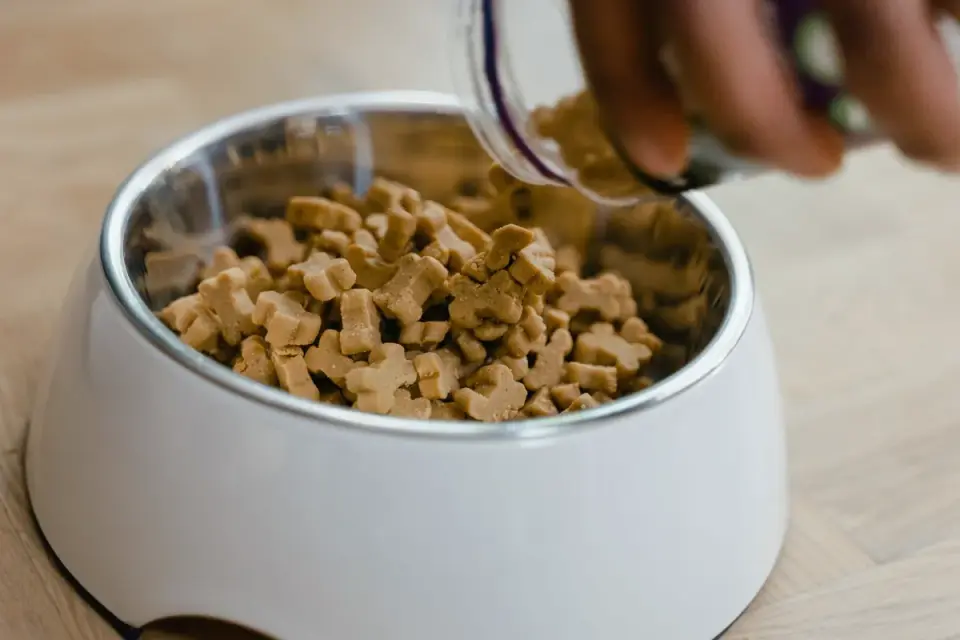
Here is the practical catch, and it has nothing to do with chemistry. A whole chew is a fixed dose; a bowl dusted with crumbs is only a full dose if your dog finishes the bowl. Senior dogs graze, wander off, and leave the last third, which quietly turns a labeled serving into a guess. Two small habits fix most of it. Mix the crumbled chew into a modest amount of food your dog reliably cleans up rather than the whole dinner, and when the serving is two chews a day, split it across two meals so a skipped bowl only costs half a dose.
Watch the first few meals before you assume anything is working.
Timing, storage, and a realistic clock
Because resveratrol fades in light and air, prepping a week of crushed chews in advance quietly undoes part of what you paid for. Crumble one serving at a time, stir it in, and serve it, and keep the intact chews stored the way the label directs — usually cool, dry, and out of sunlight — until the moment you use them.
Longevity ingredients work on slow cellular housekeeping, not on a switch you can flip overnight. Structure/function support means realistic expectations: gradual, modest shifts — a bit more willingness to move, steadier engagement — read over weeks to months rather than a single evening. A short weekly note on your dog’s baseline behavior will tell you far more than staring at tonight’s bowl.

When to check with your veterinarian first
Crushing is fine for most soft chews, but a handful of situations earn a phone call. If your dog takes prescription medication, ask whether any supplement ingredient interacts, since resveratrol and quercetin can influence how some drugs are metabolized. If a fading appetite is the reason you started crushing, treat that as a sign worth examining rather than only a texture problem to engineer around. And if the chew is actually a coated tablet or capsule, let your veterinarian confirm before you alter it.
The better question to sit with isn’t whether the chew can be crushed — it’s what you want the next six months of your senior dog’s routine to feel like, and whether this small change makes the good days easier to string together?
Frequently asked questions
Will crushing a longevity chew reduce how well it works?
For a true soft chew, no. Those actives are formulated for immediate release, so crumbling one and mixing it into food does not defeat any coating. The bigger risk is your dog not finishing the bowl and missing part of the dose.
Can I crush a longevity tablet or capsule the same way?
Not automatically. Enteric-coated and modified-release tablets or capsules are built to survive stomach acid or release slowly, and crushing them can ruin the dose. Check the label or ask your veterinarian before altering a coated form.
Should I mix the crumbs into food that contains fat?
A little fat can help. Quercetin and resveratrol are fat-soluble, and co-ingesting quercetin with dietary fat raised absorption in one human trial, so mixing the crumbs into food with some fat is reasonable.
Sources
- Checking if tablets can be crushed or capsules opened — Specialist Pharmacy Service
- A randomized, controlled clinical trial demonstrates improved owner-assessed cognitive function in senior dogs receiving a senolytic and NAD+ precursor combination — Scientific Reports
- Development and Validation of a Stability-Indicating HPLC Method for the Simultaneous Determination of trans-Resveratrol and cis-Resveratrol in an Injectable Solution — Journal of Analytical Methods in Chemistry
- Dietary Quercetin and Kaempferol: Bioavailability and Potential Cardiovascular-Related Bioactivity in Humans — Nutrients