
On this page
Jesse noticed it during a birthday party in Springfield, Missouri. Georgette, his 9-year-old spayed Cavapoo, kept licking her lips and yawning wide while guests leaned in to pet her. On a American Veterinary Society of Animal Behavior: dog body language chart most owners would label that “tired” or “calm.” She was neither.
Expectation first: a chart can teach vocabulary, but it cannot translate a sentence. Dogs speak in clusters — ears plus eyes plus mouth plus tail plus posture, all filtered through place, history, and health. If you judge one signal alone, you will misread your dog at least half the time.
Vets often see the same mix-up in the exam room. An owner reports “guilty” eyes or a “stubborn” turned head. In practice, those moments are usually stress displacement: lip licking, yawning, shake-offs, paw lifts, or sudden sniffing when the social pressure feels too high.
Why charts get stress wrong
Most charts show one frozen icon per emotion. Real dogs move.
A tucked tail with soft, squinty eyes on a familiar couch means something different from the same tucked tail with a hard stare, closed mouth, and frozen weight at a dog park. The Merck Veterinary Manual describes social behavior in dogs as context-dependent communication, not fixed reflexes, which is why posture and setting have to be read together.
That is the core trade-off of any chart. It is useful for learning names for signals. It is misleading as a diagnosis.
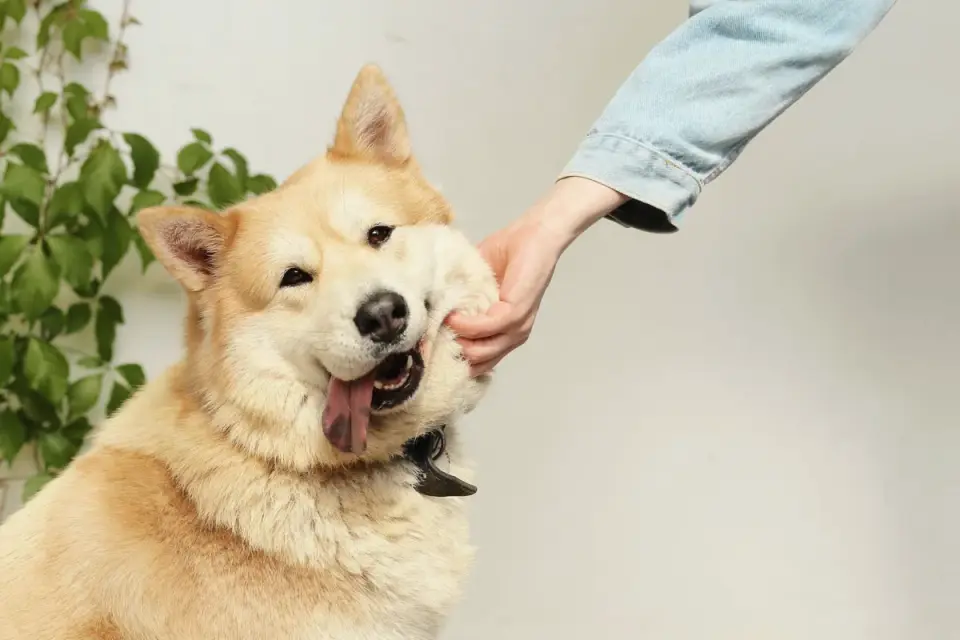
Read the cluster, not the cue
Start with the baseline you know. How does your dog normally carry ears, tail, and weight when relaxed at home?
Then look for change in three places at once:
Face and mouth. Soft eyes, loose jaw, and slow blinks point toward ease. Hard stare, whale eye, wrinkled muzzle, closed tense mouth, or rapid lip licking point toward unease. Yawning counts only when paired with other tension.
Body and weight. Leaning forward, loose and wiggly, is inviting. Rocking back, crouching, freezing, or shifting weight away is protective. A wag alone tells you arousal level, not friendliness. Height and speed matter more than side.
Behavioral breaks. Shake-offs out of context, sudden scratching, sniffing the ground mid-greeting, turning the head away, or walking off to drink are often attempts to pause pressure. That pattern is easier to spot than any single ear position.
One cue is a rumor. Three together are a report.
Stress versus fear, pain, and age
This distinction changes what you do next.
Stress builds gradually: panting when it is not hot, pacing, yawning every 30 seconds, inability to settle. Fear stops behavior cold: freeze, flight, or tucked, trembling stillness. Pain often looks like avoidance around one body area, a new reluctance to jump or be touched, or a sudden change in a senior dog that loved handling before.
Georgette showed the senior-dog version. At nine, with mild stiffness and party noise, she moved 10 feet to sit under a chair after three yawns in two minutes. Distance was her clearest sentence.
If you see growling around touch, that deserves its own careful read. Why Your Dog Growls When You Pet Him: A Vet-Reviewed Guide explains why a growl is information to respect, not defiance to correct.
What to do in the moment
Lower pressure before you add training.
Give space. Turn sideways. Stop reaching over the head. Let the dog approach. Count to five and watch whether the body softens. For most mild stress, 5 to 20 minutes of quiet in a familiar room resets the baseline better than treats or coaxing.
Do not punish displacement signals. Correcting a lip lick, yawn, or growl removes warning without removing worry. The next signal will be louder.
Track patterns for your veterinarian: when it happens, where, who was near, what the whole body did, and how long recovery took. Video of 30 to 60 seconds helps far more than a single photo matched to a chart.
If play with another dog looks rough, compare loose versus stiff bodies. Play Bow or Aggression? How to Tell If Dogs Are Playing or Fighting walks through that split. If mouthing tips into nipping during arousal, How to Stop Puppy Biting and Mouthing covers low-stress interruption. For dogs that shadow you after stressful events, Independence Training for a Velcro Dog: How to Stop the Constant Shadowing is a steady next step.
My take, and when I am wrong
I counsel owners to trust context over icons: whole body plus setting plus history, every time.
The best reason to choose differently is speed. A chart is fast, and in a busy shelter or park a quick guess feels better than no guess. I still land on the slower read because fast and wrong can lead to a flooded dog, a forced greeting, or a bite that was telegraphed for minutes.
Seek prompt help for freezing with a hard stare, snapping when approached, panic that does not resolve within an hour, or any sudden behavior change with appetite, gait, or bathroom changes. Those need a medical rule-out and a behavior plan, not a poster.
Charts teach words. You still have to listen to sentences.
Frequently asked questions
What is the most misread signal on a dog body language chart?
Yawning, lip licking, and tail wagging. Each can mean relaxed, conflicted, or aroused depending on eyes, posture, and setting, so read them as part of a cluster.
How can I tell stress from tiredness?
Look for repetition and tension. Occasional yawns with soft eyes and a loose body suggest tiredness. Repeated yawns with panting, pacing, avoidance, or a tense face suggest stress.
Sources
- Position Statements — American Veterinary Society of Animal Behavior
- Social Behavior of Dogs — Merck Veterinary Manual