On this page
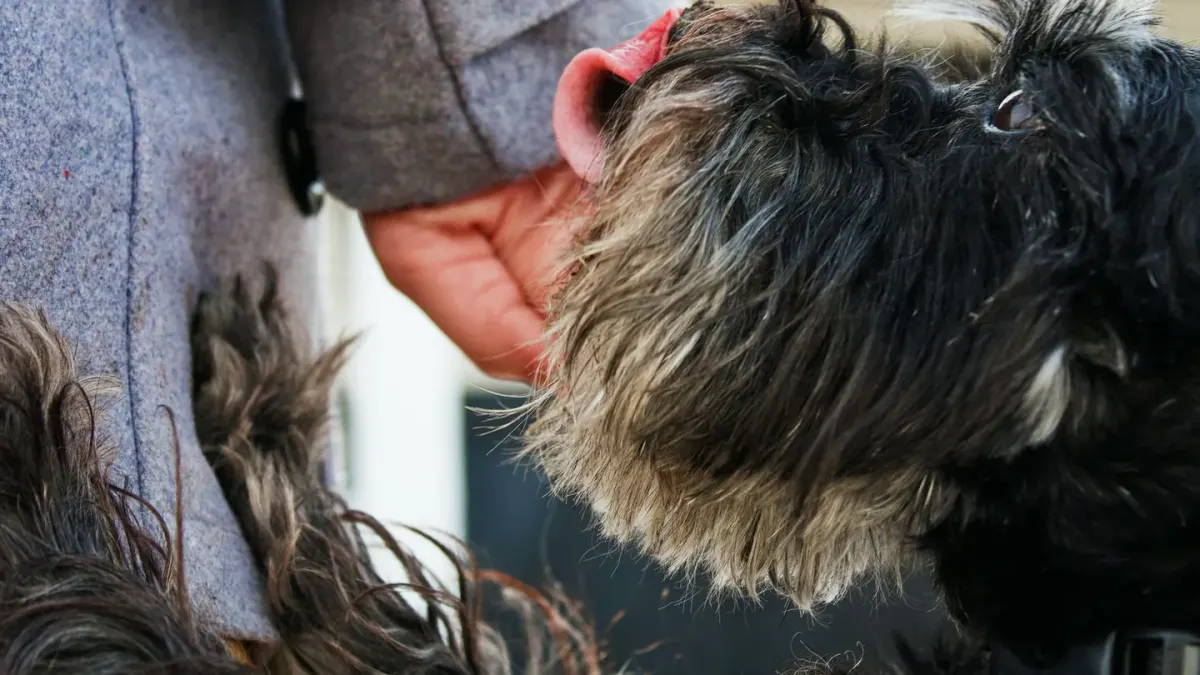
Dexter, a two-year-old shepherd mix, could not stay in a room without his owner. Kitchen, bathroom, garage — it did not matter. If she stood up, he stood up. Her trainer’s first question was not “how do we stop this” but “what is the dog getting out of it.” That question is the entire key to velcro behavior.
What Velcro Behavior Actually Is
A dog that shadows its person from room to room is usually managing uncertainty. Proximity is cheap insurance: if the owner is always in sight, nothing unexpected can happen without the dog noticing. This is an attachment strategy, not a training failure, and it shows up more in dogs with a history of multiple homes, a recent change in routine, or naturally high sensitivity to their environment.
It is not always a problem. A dog that ambles after you but settles fine on a mat nearby is simply keeping company. The pattern worth working on is the one where the dog cannot rest unless it can see or touch you, paces when a door closes between you, or startles awake the moment you leave a chair.
Building Tolerance for Distance, One Step at a Time
AVSAB recommends reward-based methods for every category of training, including behavior problems like this one, and steers owners away from correction-based fixes that rely on punishing the dog for following. Velcro behavior responds best to the same logic: reward the dog for choosing distance, rather than removing access to the owner outright.
A workable sequence looks like this:
- Teach a settle cue on a mat or bed, and reward the dog generously for staying there while you move a few feet away.
- Increase distance and duration gradually — a few seconds longer, a few steps farther, only once the previous step is easy.
- Reward the dog for staying put when you leave the room and calmly return, rather than making departures a big event.
- Practice during calm, low-stakes moments, not right before you actually need to leave the house.
A short-term study on treating separation-related problem behavior found that dogs improved when owners used a structured protocol built around gradually increasing time apart and rewarding calm behavior at reunion, rather than relying on comfort items alone, according to research PMC: using owner return as a reinforcer. The mechanics are similar to velcro-dog work even when true separation anxiety is not present: distance has to be practiced in small, successful doses.
Progress is rarely a straight line.
Some days the dog will hold a three-minute settle with ease and then struggle with thirty seconds the next morning. That is normal nervous-system variability, not a sign the plan has failed.
Where Calm-Support Tools Fit In
Behavior work does the heavy lifting, but some owners look at calming ingredients to take the edge off during the training window. The evidence here is modest and should be read as supportive, not corrective. A recent review on plant-derived compounds noted that chamomile has long-standing traditional use for relaxation, and that for many species, the supporting evidence is still mainly preclinical or based on that traditional use, according to Biomedicines. Ashwagandha has a stronger human evidence base: a systematic review analyzing multiple randomized controlled trials concluded that ashwagandha has a moderate positive impact on stress reduction and cognitive performance, according to Cureus.
None of this replaces the training itself, and none of it is a dosing recommendation for dogs specifically — it is general context on ingredients owners may see marketed for canine calm. If you are considering a calming chew or supplement, it is worth knowing how that category is actually verified; our explainer on cGMP certification versus NASC membership breaks down what each standard actually checks.

Reading the Difference Between Attachment and Fear
Velcro behavior sometimes overlaps with fear-based reactivity, and it helps to be able to tell the two apart. A dog that only shadows you during storms, fireworks, or after something startling — like the pattern described in our piece on dogs that panic at the garbage truck — is showing situational fear, not general attachment anxiety, and the intervention differs. Likewise, a dog that stiffens or growls when touched while shadowing you is communicating discomfort, not just seeking closeness; our guide on why dogs growl when petted covers how to read that signal without punishing it.
When to Loop In a Professional
A dog that has always been independent and suddenly cannot leave your side deserves a veterinary check before more training. Sudden-onset clinginess can reflect pain, sensory changes, or cognitive decline in older dogs, and ruling those out first keeps the training plan from working against an unaddressed medical issue.
Dexter’s owner did not fix the shadowing in a weekend. Over six weeks of short daily settle sessions, though, he went from trailing her across the house to holding a relaxed down on his bed while she cooked dinner one room away. That is the realistic target: not a dog that never wants your company, but one that can be comfortable without it for a while.
Frequently asked questions
Is it bad to let my dog follow me everywhere?
Not inherently. Many dogs simply enjoy proximity. It becomes worth addressing when the dog cannot settle without you in sight, paces at doors, or shows distress the moment you move to another room.
How long does independence training usually take?
Most owners see partial change within two to four weeks of daily, short sessions. Dogs with a longer history of constant proximity, or true separation-related distress, often need six to eight weeks and sometimes professional support.
Should I ignore my dog to fix velcro behavior?
No. Withdrawing attention across the board tends to increase anxiety rather than reduce it. The more reliable approach rewards calm distance while keeping affection available on a predictable schedule.
Sources
- Wild Flora Species from Romania with Anxiolytic and Antidepressant Potential: A Global Perspective — Biomedicines
- Ashwagandha as an Adaptogenic Herb: A Comprehensive Review of Immunological and Neurological Effects — Cureus
- AVSAB Position Statement on Humane Dog Training — AVSAB
- Using Owner Return as a Reinforcer to Operantly Treat Separation-Related Problem Behavior in Dogs — PMC