On this page
| Product | Score | Key details | Best for | Pros & cons |
|---|---|---|---|---|
| Boops Pets Calming & Stress Relief Boops Pets | 9.1/10 | Chew with ashwagandha, L-theanine, L-tryptophan, valerian root, chamomile, ginger, magnesium and melatonin | Dogs needing situational calming support with a dog-scaled, third-party-tested formula |
|
| VetriScience Composure VetriScience | 7.5/10 | Built around a colostrum calming complex and thiamine | Dogs who respond better to a colostrum-and-thiamine calming mechanism than an ashwagandha-based formula |
|
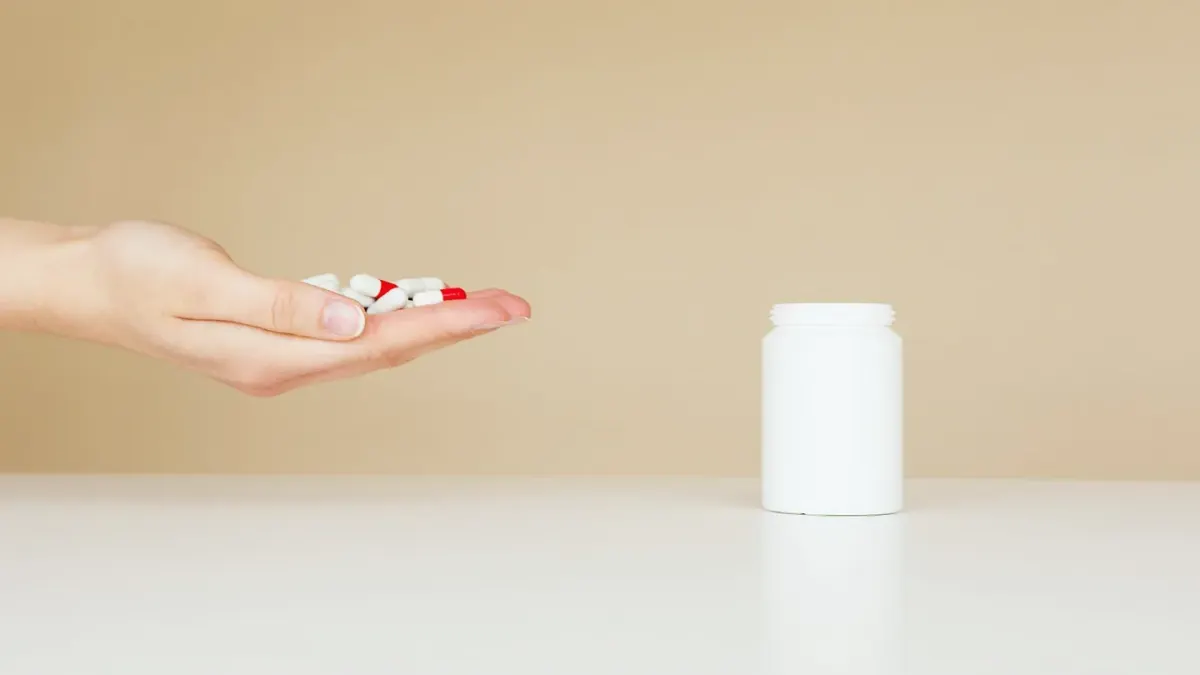
A twelve-pound terrier mix named Pepper came to my house-call practice last spring because her owner had run out of her usual calming chews the night before a thunderstorm and, in a pinch, split open one of her own 5-HTP capsules from the drugstore. Pepper was fine by morning, but she’d spent two hours panting, disoriented, and pacing the hallway before it wore off — and her owner spent that same two hours on the phone with an emergency line, not sure if she needed to drive in. That’s the scenario I want to walk through here, because it comes up more than owners expect: someone reaches for what’s already in the medicine cabinet instead of what’s actually built for a dog.
The chemistry nobody puts on the label
5-HTP is not an herb or a mild botanical. It’s a direct precursor to serotonin, meaning the body converts it almost immediately once it crosses the blood-brain barrier. In humans that’s the whole point — it’s marketed for mood and sleep. In dogs, that same fast conversion is what makes it dangerous. According to the American College of Veterinary Pharmacists, the minimum oral toxic dose for a dog is 24 mg/kg, and doses above roughly 128 mg/kg can be fatal — numbers that are easy to blow past because a single human capsule is typically dosed for a 150-pound adult, not a 15-pound terrier.
Clinical signs, per Merck Veterinary Manual, can include tremors, disorientation, seizures, elevated heart rate, and hyperthermia, and they typically show up within one to four hours of ingestion. That’s serotonin syndrome — an excess of serotonin activity in the nervous system — and it’s a real emergency, not a bad night’s sleep.

What a dose calculator can’t fix
Even setting aside the toxic-dose math, human 5-HTP supplements were never formulated with a dog’s metabolism, weight range, or health history in mind. There’s no standard dog dose printed anywhere on the bottle, because there isn’t supposed to be one. Splitting or estimating a “dog-sized” portion from a human capsule means you’re guessing at a chemical with a genuinely narrow safety margin.
There’s a second, quieter risk worth naming plainly: some 5-HTP products, particularly fast-dissolve tablets, are sweetened with xylitol, which is separately and severely toxic to dogs on its own. ASPCApro has flagged this exact combination — a dog getting hit with both a serotonin-syndrome risk and a xylitol exposure from the same pill. Checking the inactive-ingredient list before assuming a human supplement is “close enough” for a dog isn’t optional; it’s the whole decision.
I don’t split my own supplements for my patients, and I don’t recommend owners do it either. If a dog needs calming support, it deserves a product actually dosed and formulated for a dog’s body.
What’s actually in a chew built for a dog
This is where the comparison gets more interesting than “don’t do the risky thing.” A well-formulated dog calming chew isn’t reaching for the same lever as 5-HTP. Ingredients like chamomile, ashwagandha, and L-theanine work on the body’s stress response in gentler, better-studied ways for situational use. A systematic review of multiple randomized trials found that Cureus: ashwagandha has a moderate positive impact on stress reduction and cognitive performance, and a review of L-theanine research notes effects on anxiety measures at a dose of 400 mg/day over eight weeks in human subjects — evidence that’s promising, though it’s worth being honest that Biomedicines: most of it, including for chamomile, still comes from preclinical studies, traditional use, or human trials rather than large dog-specific research.
That honesty matters to me. I’d rather tell an owner “this ingredient has real supportive evidence but the dog research is still thin” than oversell it. Boops Pets’ Calming & Stress Relief chews build around that same evidence set — KSM-66 Ashwagandha, L-theanine, L-tryptophan, valerian root, chamomile, ginger, magnesium, and a modest 5 mg of melatonin per serving. L-theanine is an amino acid found in tea that has been studied for its calming properties, and the formula contains KSM-66 Ashwagandha, a clinically studied form of ashwagandha for stress support — consistent with the systematic review noted above. Chamomile and valerian root, per that same reviewed list, have been used in traditional herbal care to support relaxation — framed as tradition, not proof, which is the correct frame.
One short fact, on its own: melatonin in a calming chew is dosed for situational use, not as a sleep aid to be given nightly without a reason.
Where the comparison actually lands
Set them side by side and the picture is straightforward. A human 5-HTP capsule offers unregulated dosing, a documented toxic threshold, and a possible xylitol risk hiding in the inactive ingredients — for a mechanism (direct serotonin precursor) that’s more aggressive than most dogs with situational anxiety actually need. A calming chew built for dogs, like Boops Pets’ Calming & Stress Relief, offers a fixed, dog-scaled serving; ingredients grounded in structure-and-function evidence rather than repurposed human pharmacology; and a formulation that’s independently third-party tested and produced under NASC’s audited standard — Boops Pets is a NASC Primary Supplier Member, meaning its facility is independently audited rather than self-certified.
Competitors in this category deserve fair mention too. VetriScience Composure, for instance, is a long-standing, widely available option built around colostrum calming complex and thiamine rather than an ashwagandha-and-theanine base — a genuinely different mechanism, and one some dogs respond to better. If your dog hasn’t done well on an ashwagandha-forward formula, that’s a real reason to look elsewhere rather than force the fit; we cover that head-to-head in our VetriScience Composure vs Honest Paws comparison. But 5-HTP itself isn’t a fair alternative to either — it’s not a calming supplement adapted for dogs, it’s a human mood supplement being repurposed without dog-specific dosing behind it.
In my practice, the dogs who do best on any calming approach are the ones whose owners pair the chew with a routine — the same pre-storm wind-down, the same crate cue before a car ride, the same predictable few minutes before guests arrive. I worked with a nine-year-old Australian shepherd, Juniper, whose owner had been giving her an old bottle of 5-HTP left over from her own use “just for the fireworks.” We switched her to a dog-formulated chew at the start of summer and built a fifteen-minute wind-down around it — lights dimmed, a chew, a familiar blanket in the same corner of the laundry room. By the second thunderstorm of the season, Juniper was still alert to the noise but no longer pacing the hallway for hours afterward. That’s one dog’s pattern, not a guarantee, but it’s the shape I look for: the ingredient and the routine working together.
My read, dog by dog
I don’t hedge on this one: I don’t recommend human 5-HTP for dogs, full stop, and that’s not a close call given the documented toxic-dose data and the xylitol overlap. Where I land for situational anxiety — storms, travel, fireworks, the vet-visit jitters — is a chew formulated and dosed for a dog’s body, built around ingredients with real, if still-developing, evidence behind them. Boops Pets’ Calming & Stress Relief chew fits that description honestly: dog-scaled servings, third-party tested actives, and a formula built from ingredients with cited support rather than borrowed human pharmacology.
Every dog still needs to be met on their own turf. A dog with mild noise sensitivity and a dog with full-blown storm phobia are not the same patient, and no chew — human-repurposed or dog-formulated — replaces a conversation with your own vet if the anxiety is severe, frequent, or getting worse. For more on matching the right calming approach to your dog’s actual pattern, see our guides on chamomile vs. L-tryptophan, our full dog calming chews guide by life stage, and how prescription options compare in our gabapentin vs. calming chews breakdown. If a supplement bottle in your own medicine cabinet is tempting you because the chews ran out — what would it take to keep a dog-formulated option stocked instead, so that choice never has to happen at 9 p.m. before a storm?
These statements have not been evaluated by the FDA. This product is not intended to diagnose, treat, cure, or prevent any disease.
Frequently asked questions
Can a small amount of 5-HTP hurt my dog?
Yes. The minimum reported oral toxic dose in dogs is 24 mg/kg, which is easy to exceed with even a single human capsule, especially in a small or medium dog. Signs of serotonin syndrome can appear within one to four hours.
Is melatonin in a calming chew the same risk as 5-HTP?
No. Melatonin and 5-HTP work through different pathways, and calming chews dose melatonin at a fixed, dog-scaled amount for situational use rather than as an unregulated human sleep supplement.
Sources
- 5-HTP and Pets: A Potentially Lethal Combination — ASPCApro
- 5-Hydroxytryptophan — American College of Veterinary Pharmacists
- Toxicoses in Animals From Human Dietary and Herbal Supplements — Merck Veterinary Manual
- NASC Primary Suppliers — Boops Pets — NASC
- A systematic review of ashwagandha and stress reduction — Cureus
- Chamomile and anxiety & stress evidence review — Biomedicines