On this page
Biscuit, a ten-year-old Lab I saw last winter, managed the stairs fine all day. The trouble came after dark. Once the house went quiet and the floors cooled, she would stop at the bottom of the staircase, look up the flight, and wait — as if she were pricing the climb before agreeing to it. Her owner had already bought a tub of glucosamine chews and wanted a straight answer to one question: were they doing anything?
It’s the right question to ask before a supplement quietly becomes a lifelong habit.
What a hard night on the stairs usually signals
Stiffness that shows up at night, eases once a dog is moving, and clusters around the stairs is one of the most recognizable early patterns of joint trouble. Osteoarthritis is the usual culprit, and it’s badly under-recognized. In a large UK primary-care study published in Scientific Reports, appendicular osteoarthritis was diagnosed in about 2.5% of dogs in a single year across more than 455,000 animals — and the authors note the true figure is almost certainly higher, because the first signs are exactly this quiet: worse after rest, easy to file under “just getting old.”
The stairs make it obvious for a reason. Going down loads the very joints that ache, and doing it after hours of lying still on a cool floor is the worst-case version — cold, stiff, and unwarmed.
In the acupuncture-and-TCM framework I also trained in, cold and stiffness that loosen with movement read as stagnation: Qi and blood not moving freely through the joints and the meridians that cross them. You don’t have to accept the metaphor to use what it points at. In plain terms it lines up with what owners actually describe — a dog who is stiffest after resting on a cold floor and who limbers up once she’s on her feet. That pattern is a cue to act, not a diagnosis.
What glucosamine actually does — and what it doesn’t
Glucosamine is a raw material the body uses to build and maintain cartilage and joint fluid. In the lab it looks protective: a 2025 review in the Journal of Veterinary Medical Science reports that glucosamine can prevent experimentally induced cartilage degradation in vitro, and catalogs several in vitro and experimental studies pointing to potential benefit. That’s the encouraging half.
The honest half is in the review’s own title — “do they work?” The jump from a petri dish to a living, stair-climbing dog is where the evidence thins and turns mixed. Structure-and-function support is a reasonable hope; a cure or a guaranteed fix is not. Glucosamine may help support the joint’s own maintenance, and some owners do see a real change over weeks. It is a support, though — not a painkiller, and not something every dog responds to.
Give it time, and give it honesty.
If you try it, judge it over six to eight weeks rather than six to eight days, and keep a plain log of the one thing you care about: how she takes the stairs at night.
Reading the rest of the label
Few joint chews are glucosamine alone. Chondroitin usually travels with it; work in Frontiers in Veterinary Science describes chondroitin as supporting healthy synovial fluid homeostasis — the fluid that lets a joint glide instead of grind. Green-lipped mussel shows up for its omega-3 fatty acids and glycosaminoglycans, though the strongest data there is still early and preclinical. In one rat study in Nutrients, green-lipped mussel oil, alongside blue mussel and krill oils, alleviated paw swelling and reduced inflammatory markers including rheumatoid factor, anti-CCP antibody, and cytokines such as TNF-α and IL-17. That’s a reason to stay open-minded, not proof — a rat model is not your dog.
To compare specific formulas and doses side by side, our companion guide to the best joint supplements for senior dogs is the place to look. For the wider question of aging joints and cellular health, what NAD+ does for senior dogs is a useful next read.
The plain-guidance version
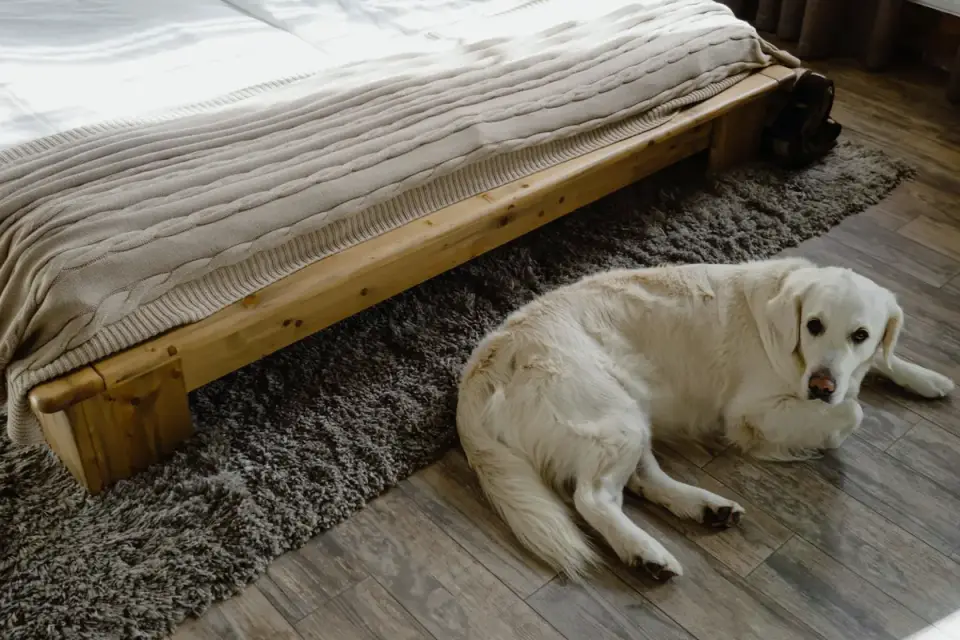
Here the meridian thinking becomes an ordinary to-do list. Warmth eases stagnation, so keep her bed off cold tile and out of drafts; a raised, padded bed earns its keep. Gentle, regular movement beats both strict rest and weekend-warrior walks — short, daily, on-leash. Traction matters more than owners expect: a runner or a few nonslip rugs along her nighttime route can turn a dreaded descent into a plain one. And keep her lean, because every extra pound is weight the joint carries down every single step.
If you’re tempted to add anti-inflammatory botanicals on top, read first — quercetin for dogs is one example — and clear any stack with your veterinarian, since “natural” is not the same as “no interactions.”
Where to go from here
The next good step isn’t a bigger tub; it’s a conversation. Bring your night-stairs log to your veterinarian, because persistent trouble on the stairs earns an exam and a diagnosis before it earns a spot in the supplement aisle. Glucosamine may help support a joint that has been properly assessed — it can’t tell you what’s wrong with one that hasn’t. Start there, give any supplement an honest trial window, and let the stairs themselves tell you whether it’s working.
Frequently asked questions
How long before glucosamine helps a dog with stairs?
Plan on a trial of about six to eight weeks, not days. Glucosamine may help support cartilage and joint-fluid maintenance over time; it is not a fast-acting painkiller. Track one concrete thing — how your dog handles the stairs at night — so you can judge honestly whether it is doing anything.
Is trouble on the stairs at night always arthritis?
Not always. Stiffness that is worse after rest and eases with movement is a classic joint pattern, but back pain, injury, and other conditions can look similar. Persistent difficulty on the stairs deserves a veterinary exam and diagnosis before you settle on a supplement.
Can I give glucosamine alongside my dog's other supplements?
Often, but clear it with your veterinarian first. Many joint chews already combine glucosamine with chondroitin and green-lipped mussel, so stacking more on top — including anti-inflammatory botanicals — can add up in ways that are easy to miss. "Natural" does not mean "no interactions."
Sources
- A review of the clinical efficacy and adverse effects of disease modifying osteoarthritic drugs (DMOADs) in dogs with special focus on glucosamine and pentosan polysulfate; do they work? — Journal of Veterinary Medical Science
- Protective effects of turmerosaccharides rich extract of Curcuma longa L. in osteoarthritic dogs — Frontiers in Veterinary Science
- Therapeutic Effect and Underlying Mechanism of Blue Mussel (Mytilus galloprovincialis) Oil on Adjuvant-Induced Rheumatoid Arthritis in Rats — Nutrients
- Prevalence, duration and risk factors for appendicular osteoarthritis in a UK dog population under primary veterinary care — Scientific Reports