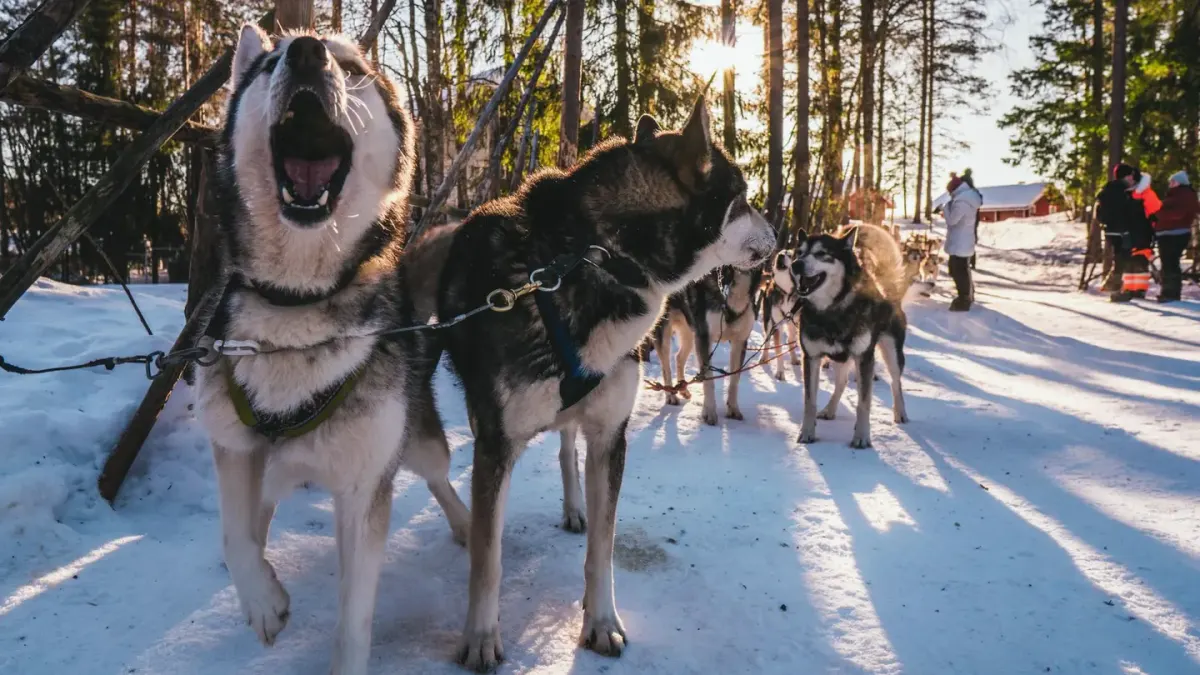
The first husky I examined for a vocalization complaint wasn’t actually sick. He was a two-year-old neutered male named Kodiak, 52 pounds, and his owner brought him in convinced something was neurologically wrong because he “argued back” every time she said no. She’d recorded video on her phone: she’d say “Kodiak, no,” and he’d answer with a rising, warbling “wooo” that did, unmistakably, sound like a word. It happened at the door, at mealtime, and every evening around 6 p.m. when she got home from work. Nothing on exam suggested pain, and his weight and coat were normal. What she was describing wasn’t a symptom. It was a Siberian Husky doing exactly what the breed was shaped to do for roughly three thousand years: stay in vocal contact with its group.
the sound isn’t barking, and that distinction matters
Most dog breeds default to barking because barking travels well over short distances and signals a single, immediate thing — stranger, threat, excitement. Huskies bark comparatively rarely. Instead they lean on howls, yodels, and a modulated, pitch-shifting “woo” that people describe as talking. According to the American Kennel Club, huskies developed this range because they were bred as sled dogs working in large teams across open, snow-covered terrain, where a howl carries farther and communicates more nuance than a bark ever could. That’s a working-dog adaptation, not a temperament flaw, and it’s also not unique to any one line — it shows up reliably across the breed regardless of coat color or eye color, which tells you it’s structural, not incidental.
The mechanism is worth understanding before you try to manage it. Howling is a low-frequency, sustained vocalization that domestic dogs inherited from wolves, whose howls function to reunite a scattered pack and mark territory across distance. What differs in huskies is the addition of pitch-bending and rapid tonal shifts layered onto that base howl — the “woo-woo” cadence — which most researchers attribute to selection pressure for group cohesion in sled teams rather than territorial marking alone. A husky separated from its people, even briefly, is drawing on the same circuitry that once kept a scattered team connected across miles of tundra.
when talking becomes a message worth answering

Here’s where I ask owners to slow down and actually catalog the pattern, because “my husky talks a lot” and “my husky is vocalizing excessively” are two different conversations. Normal talking is short, situational, and resolves once the trigger passes — the door opens, the leash comes out, the owner answers. According to VCA Animal Hospitals, vocalization becomes a behavioral concern when it happens for no obvious reason, occurs at inappropriate times such as the middle of the night, or persists well past the point where the dog’s need has been addressed. Demand vocalizing — talking that gets louder or repeats until the owner responds — is functionally reinforced: if it worked once, the dog will use it again, and the frequency tends to climb, not plateau.
I had a case a few years back that illustrates the other end of this. A nine-year-old spayed female husky named Nova had “talked” her whole life, per her longtime owner, but the pattern changed over about six weeks — she started vocalizing at 2 and 3 a.m., pacing before and after, and the sound had shifted from her usual short “woo” bursts to longer, more distressed-sounding howls. Her owner initially chalked it up to a stubborn streak getting worse with age. On exam, Nova had early signs consistent with cognitive changes common in aging dogs, and once we addressed her nighttime routine and lighting, the pattern eased. The lesson wasn’t that huskies talk less as they age — it’s that a genuine shift in pattern, especially timing and tone, is the signal to bring in, not the volume itself. ASPCA guidance on whining makes a similar point: sudden changes in a previously stable vocal pattern warrant a look at medical causes — pain, hearing loss, thyroid disease, cognitive decline — before assuming it’s purely behavioral.
what actually helps, and what doesn’t
I’ll say the unpopular part plainly: you are not going to breed-proof a husky out of talking, and trying to suppress it entirely usually backfires into worse behavior, because you’re fighting three millennia of selection with a training plan built for a breed that never needed one. The realistic target is teaching the dog when vocalizing gets a response and when it doesn’t, not silence.
What I actually recommend, in order of what moves the needle: meet the exercise floor first, because a husky that hasn’t had real physical output will talk out of excess energy regardless of anything else you do; keep departures and returns low-key so the dog doesn’t learn that arrivals are worth vocalizing over; and reward quiet moments deliberately rather than only reacting once the talking starts. None of this eliminates the behavior, and it shouldn’t — a husky that never vocalizes is arguably the more unusual case. The goal is a dog whose talking stays proportionate to what’s actually happening around it.
Owners weighing whether a husky fits their household in the first place should look past the vocal reputation to the whole picture — energy level, grooming, and how the breed does with routine matter as much as noise tolerance, and that overlaps with what to evaluate in any best dog breeds for first-time owners decision. Vocalization also interacts directly with living situation: a husky’s talking reads very differently in a house with a yard than it does through shared walls, which is the same calculus covered in best dog breeds for apartment living. And because huskies are a high-drive breed with real exercise needs, they’re rarely the right match for the kind of household outlined in best low-maintenance dog breeds for busy people — the talking is manageable; the exercise requirement underneath it is not optional.
By the time Kodiak came back for his annual exam, his owner had stopped treating the “arguing” as a problem and started treating it as a running conversation — she’d talk back, he’d answer, and the demand-vocalizing at the door had actually dropped once he wasn’t the only one initiating it. That’s usually where this settles: not eliminating the talking, but understanding what it’s for. A husky “arguing” with you at the door is doing the job the breed was built to do. A husky howling alone at 3 a.m. in a pattern that’s new is telling you something else, and that one is worth a veterinary visit, not a training video.
Frequently asked questions
Is it normal for a husky to "talk back" when told no?
Yes. Huskies were bred for vocal range rather than barking, and a rising, tonal "woo" in response to being told no is typically normal breed-driven communication, not defiance or a medical issue.
When should husky vocalization worry me?
A sudden shift in timing, tone, or intensity — especially new nighttime vocalizing, distressed-sounding howls, or vocalizing paired with pacing or disorientation — warrants a veterinary visit rather than a training fix.
Sources
- Can Huskies Talk and What Are They Saying? — American Kennel Club
- Barking in Dogs — VCA Animal Hospitals
- Whining — ASPCA